Article: Shoe Lifts or Elevator Shoes? Which Should You Choose?
Shoe Lifts or Elevator Shoes? Which Should You Choose?
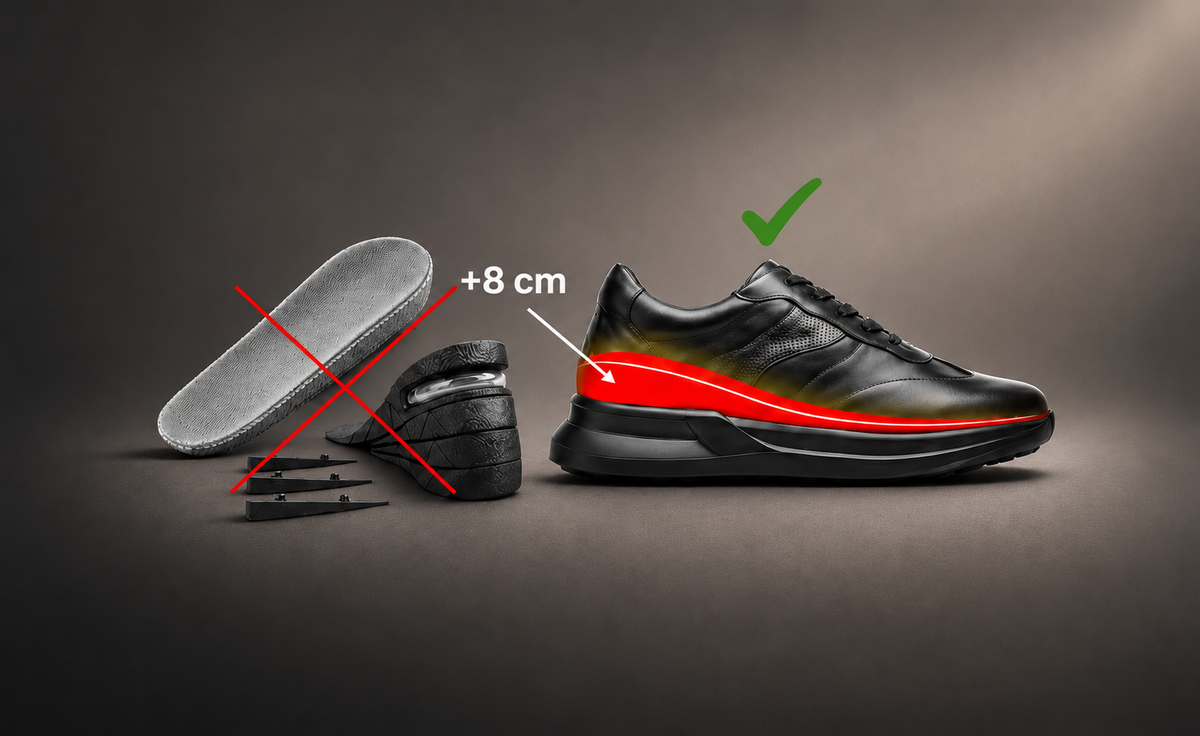
If you want to gain 2 to 4.7 inches (5–12 cm) and wear them all day, choose elevator shoes. Shoe lifts (usually 0.6 to 2.75 inches, 1.5–7 cm) are cheaper and fit the shoes you already own, but a regular shoe is not designed for a raised heel – and that affects both comfort and foot health. Below we explain how the two differ, why we advise against lifts and how much height you can gain without discomfort.
How shoe lifts work
A shoe lift is a heel wedge, usually 0.6 to as much as 2.75 inches (1.5–7 cm) high, that you slip into a regular shoe. It sounds simple, but a regular shoe has a fixed depth and a heel counter made for a foot standing flat. The higher the lift, the worse the foot fits the shoe:
- Your heel slips out. The foot is raised, so the heel counter no longer holds it and the shoe slips with every step.
- Tight over the instep and toes. The foot moves forward and up, squeezing the toes and instep, so you have to loosen the laces a lot.
- The lift shows. With a higher wedge its edge sticks out above the shoe, especially in dress shoes.
- Unstable steps. The lift moves inside the shoe and the foot has no side support.
How shoe lifts can harm your feet
A regular shoe is not made for a foot that stands a few inches higher. That is why wearing lifts in it, especially every day, can lead to health problems:
- Forefoot pain. With the heel higher, more weight shifts to the front of the foot, which is also squeezed in a regular shoe. This leads to pain under the toes and calluses.
- Risk of twisting your ankle. A foot raised on a loose insert, without a heel counter holding it, slips sideways more easily, especially on stairs and uneven ground.
- Chafing and blisters. The heel rubs against the edge of the heel counter and the toes rub against the top of the shoe.
- Pressure on the toes. Too little room at the front of the shoe can worsen toe problems such as bunions.
- Tired, aching legs. An unstable foot keeps your calf muscles and ankle working constantly, which leads to fatigue and pain after a few hours.
That is why we do not recommend shoe lifts in regular shoes, not even for a short night out. If you have foot problems, talk to an orthopaedic specialist or podiatrist before changing your footwear.
How elevator shoes work
In an elevator shoe the lift is part of the construction from the start. A hidden wedge under the heel tapers gently towards the toes, and the upper and heel counter are built higher, so your heel stays in place and your toes have as much room as in a regular shoe.
All our elevator shoes have a raised, contoured heel counter that wraps around the heel and holds it in place. That makes them very comfortable even with higher lifts.
From the outside you see a classic dress shoe, sneaker or boot with a normal sole. That is how you can gain 2 to 4.7 inches (5–12 cm) and wear them all day. Read more about the construction in our guide How do elevator shoes work?
Comparison
| Shoe lifts 0.6–2.75 in (1.5–7 cm) | Elevator shoes | |
|---|---|---|
| Height gain | 0.6–2.75 in (1.5–7 cm), but the higher, the worse the shoe holds your foot | 2–4.7 in (5–12 cm) |
| Which shoes | Regular shoes you already own | A finished shoe with a built-in lift |
| All-day comfort | Limited: the heel slips, tight at the front | Yes, the shoe is designed for a raised heel |
| Visible? | With a higher wedge, the edge shows above the shoe | No, the lift is hidden inside |
| Stability | The insert can move | The foot is firmly supported |
| When it works | Not recommended: risk of foot pain, blisters and twisted ankles | Every day, at work, at weddings and special occasions |
What about the Faretti ergonomic insole?
Our Faretti ergonomic insole is not a height lift. It is only 0.2 inches (0.5 cm), so it adds a subtle bit of height, but its main job is comfort: memory foam cushions every step, a contoured heel zone stabilises the foot and arch support reduces fatigue during long hours on your feet. The perforated calfskin top layer lets your foot breathe.
The insole was designed to complement Faretti elevator shoes. If you want an even more comfortable shoe and an extra 0.2 inches (5 mm) of height, it is a great match. It comes in black and white, for light sneakers.
Which should you choose?
- Want to gain 2 to 4.7 inches and wear your shoes all day? Choose elevator shoes. To start, 2 in (5 cm) and 2.4 in (6 cm) styles work well, the most popular are 2.75 in (7 cm) and 3.15 in (8 cm), and for more height go for 3.5 in (9 cm), 4 in (10 cm) or 4.7 in (12 cm).
- Want your elevator shoes to be even more comfortable? Add the Faretti ergonomic insole, which also gives you an extra 0.2 inches.
- Just want to try the effect for one evening? Even then we advise against shoe lifts. Start with 2-inch (5 cm) elevator shoes instead – you can exchange them within 60 days if they are not for you.
See every style in our Elevator shoes collection.
Frequently asked questions
Can I put a shoe lift into elevator shoes?
No. Don't add height lifts to them – the shoe is already designed for a specific height and will become too tight. Faretti shoes are matched with our 0.2-inch (0.5 cm) ergonomic insole.
Are shoe lifts invisible?
Low ones are, but at an inch or more in a dress shoe the edge often shows above the shoe. In elevator shoes the lift is completely hidden inside.
How much height can I gain with elevator shoes?
Our styles add 2 to 4.7 inches (5–12 cm). With the Faretti ergonomic insole you gain another 0.2 inches (0.5 cm).
Are elevator shoes comfortable all day?
Yes, they are designed to be worn all day. If this is your first pair, start with 2–3.15 inches (5–8 cm). Find your size with our guide How to choose your size? – and if it doesn't fit, you have 60 days to exchange.